
Semiconductor Application Case Study
End-to-End Environmental, Humidity & Time Control Solution
In semiconductor manufacturing, humidity and exposure time are two critical factors affecting environmental stability. From material storage and equipment operation to process transitions and downstream handling, inadequate control of humidity or exposure time can amplify risks throughout the process, impacting material condition, equipment reliability, and process quality, ultimately contributing to cumulative defect rates.
Environmental control, therefore, is not merely about managing isolated setpoints, but about end-to-end risk management that integrates humidity stability with time control across the entire process.
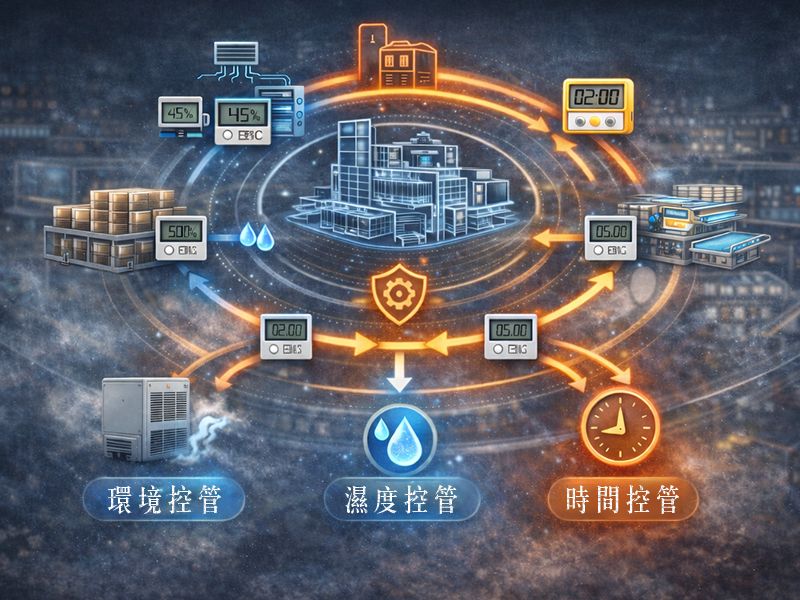
This case study demonstrates how environmental, humidity, and time control solutions are implemented at each stage of semiconductor manufacturing, using a unified control logic to support process stability, predictability, and yield improvement under diverse production scenarios.
Application Scenario|All Process Stages as Critical Nodes
During the storage of raw materials and critical components, environmental and humidity control focuses on preventing moisture absorption and performance degradation, while maintaining stable conditions to extend material usability and reduce risks associated with waiting or rework.
In front-end process areas around equipment, conditions must account for equipment operation, personnel movement, and production line rhythm, preventing short-term fluctuations in temperature, humidity, or dew point, while ensuring materials and equipment remain stable within the process cadence.
In mid-process staging and transfer zones, stable humidity and controlled dwell times help minimize variability during process transitions, reducing potential defects caused by extended waiting periods.
In downstream processing and equipment standby environments, long-term stable, low-interference environmental and time control ensures equipment reliability while reducing the occurrence of anomalies and maintenance frequency.
Material & Process Characteristics|Why Humidity and Time Are Critical Risks
Materials used in semiconductor manufacturing are often hygroscopic and environmentally sensitive. Whether wafers, packaging materials, adhesives, or critical components, prolonged exposure to unstable humidity can lead to moisture absorption, performance changes, or latent reliability risks. These risks may not appear immediately but can amplify in subsequent process stages or during long-term use.
Semiconductor production involves multiple process transitions and waiting periods. The dwell time and exposure conditions of materials between stages are often critical factors affecting quality stability. Managing environmental setpoints at individual stations alone, without controlling humidity across the full process timeline, can still result in cumulative defects and reliability issues.
Therefore, integrating material characteristics, humidity stability, and time control into a unified, end-to-end environmental control logic is essential to reduce process risks and enhance yield stability.
Core Challenge|Meeting Setpoints Alone Can Still Accumulate Time-Based Risks
Although operational requirements vary across different process stages, they face a common challenge: even if humidity or environmental specifications are temporarily met, uncontrolled exposure time and environmental fluctuations can accumulate into defect risks over long-term operation.
The true goal of control, therefore, is not merely achieving setpoint values, but ensuring stable environmental conditions are maintained throughout the entire process timeline.
Solution Approach|End-to-End Process Strategy Integrating Humidity Stability and Time Control
This case adopts an end-to-end process consistency strategy for environmental, humidity, and time control. The system design goes beyond simple setpoints, emphasizing fluctuation range, recovery speed, actual dwell time, and long-term operational reliability.
Through stable control mechanisms and continuous monitoring, each process stage maintains predictable environmental conditions under varying operational rhythms, reducing risks associated with cumulative exposure over time.
Measured Results|Supporting Process Rhythm and Reducing Defect Risk
Through this end-to-end environmental, humidity, and time control framework, environmental fluctuations and exposure times at each process stage are effectively managed, resulting in more stable material conditions and improved equipment operational consistency. The environment is no longer an uncertain factor affecting process rhythm, but a key enabler for stable operations and reduced latent defect risk.
Truly effective environmental and humidity control requires simultaneous management of both conditions and time to continuously enhance yield across the entire semiconductor manufacturing process.
Published on November 17, 2025