
Cultural Relics Scanning Equipment – Precision Humidity Control by BOSSMEN
A high-end flatbed scanning system manufactured in Germany, specifically designed for the digitization of artworks, calligraphy, paintings, and large-format flat media. Featuring a non-contact scanning architecture, it integrates high-resolution optical lenses with linear photoelectric sensors, combined with precision directional lighting to consistently capture fine textures, rich tonal gradations, and authentic material details.
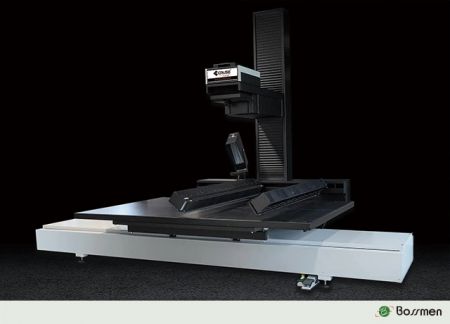
Cultural Relics Scanning Equipment
CRUSE 295ST-4.0
Cultural Artifact Scanning, Scanning Equipment, Scanning
A high-end flatbed scanning system manufactured in Germany, specifically designed for the digitization of artworks, calligraphy, paintings, and large-format flat media. Featuring a non-contact scanning architecture, it integrates high-resolution optical lenses with linear photoelectric sensors, combined with precision directional lighting to consistently capture fine textures, rich tonal gradations, and authentic material details.
The scanning platform supports originals up to 150 × 250 cm, with a standard lens offering variable resolution from 250 to 1000 dpi. At the maximum 1000 dpi setting, the single-scan capture area reaches 187 × 38 cm, producing images of approximately 1.16 billion pixels. An integrated vacuum table securely flattens curled or uneven originals, significantly enhancing image quality and workflow efficiency. Framed artworks can be scanned directly through glass or acrylic without removal, greatly reducing handling risks.
The system supports RAW, RGB, CMYK, and RGB Web output formats, making it suitable for archival preservation, professional production, and digital exhibition—an ideal solution for high-value cultural assets and large-format digitization projects.
Comparison of High-End Scanners and Camera-Based Scanning Systems
High-End Scanning System(CRUSE 295ST-4.0)
Featuring a non-contact flatbed scanning architecture combined with high-resolution optical lenses, linear photoelectric sensors, and directional professional lighting, it stably reproduces artwork details, tonal gradations, and material textures. It supports variable resolutions from 250–1000 dpi, with a maximum of approximately 1.1 billion pixels, and includes a built-in vacuum table to flatten and secure curled originals. Framed artworks can be scanned directly through glass or acrylic without removal, making it suitable for high-precision archival preservation and large-format flat artwork digitization.
Traditional Photography
It relies on manual lighting setup and on-site environmental conditions, making lighting consistency difficult to control. Large-format works are prone to color deviation and distortion. Camera pixel count is fixed, resulting in limited resolution, making it difficult to fully reproduce fine textures. Reflections often occur when photographing framed artworks, and frame removal also carries a risk of damage. It is more suitable for creative photography rather than high-precision reproduction.
High-end scanning and photography are digitization methods with different application orientations. High-end scanning focuses on accurate reproduction and preservation quality, while photography emphasizes visual presentation. Enterprises can choose the most suitable solution according to actual needs to achieve optimal digitization and environmental management results.
Product Specifications
| Model | High-End Large-Format Original Scanning System CRUSE 295ST-4.0 |
|---|---|
| Equipment Type | High-End Large Flatbed Scanning System (Non-contact scanning) |
| Scanning Method | Flatbed camera-based scanning |
| Scanning Platform Size | 150 × 250 cm |
| Scanning Unit | High-resolution optical lens + linear photoelectric sensor |
| Resolution Range | 250–1000 dpi (variable) |
| Maximum Resolution | 1000 dpi |
| Maximum Single Scan Size (1000 dpi) | 187 × 38 cm |
| Maximum Image Pixels | Approx. 1.16 billion pixels |
| Lighting System | Directional lighting kit (fixed-direction illumination to enhance image depth) |
| Original Fixation Method | Vacuum table, flattens and secures curled or uneven originals |
| Framed Artwork Support | Glass or acrylic can be scanned directly without removal |
| Supported Artwork Types | Flat documents, calligraphy, artworks, etc. |
| Output Image Formats | RAW, RGB, CMYK, RGB Web |
| Main Applications | Art archiving, cultural heritage preservation, large-format digitization |
- Gallery
 CRUSE 295ST-4.0.
 Scanning in progress.
 Detail.
 Scanning process
 Image displayed after 1:1 scan
 Zoom in on details
 Zoom in on details
 Zoom in on details
- Related Products
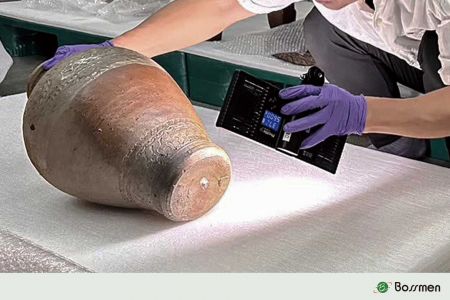
Cultural Heritage Survey
CHS
We provide comprehensive museum storage and equipment solutions to ensure the safety and preservation...
Details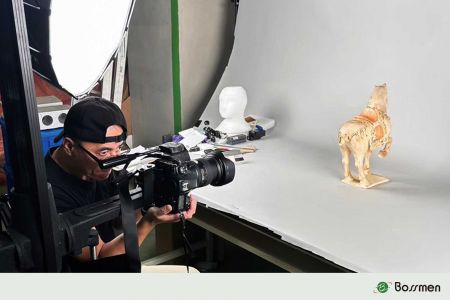
Cultural Relics Photography
CRP
Cultural Relics Photography involves the precise and professional imaging of cultural objects,...
Details
Cultural Relics Handling
CRH
Professional artifact transportation ensures the safe and secure relocation of cultural objects....
Details


 Download
 Popular Products

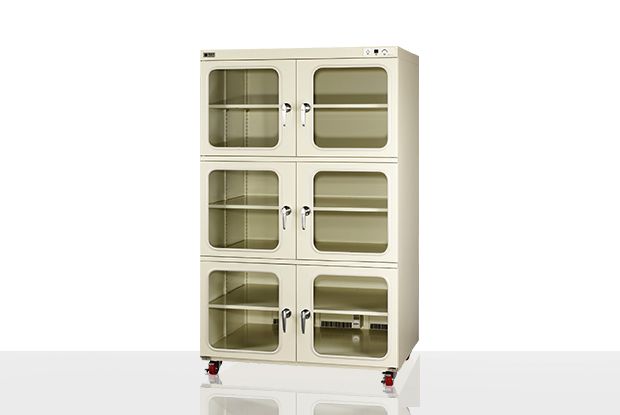

Cultural Relics Scanning Equipment – Precision Humidity Control by BOSSMEN
The Cultural Relics Scanning Equipment is designed to protect sensitive materials, electronics, and instruments from moisture damage. BOSSMEN integrates advanced humidity control systems to maintain stable RH levels, ensuring reliability in manufacturing, laboratories, and research facilities.
Engineered with precision and durability, the Cultural Relics Scanning Equipment offers consistent performance for long-term storage and process environments. From cleanrooms to quality labs, BOSSMEN products help users reduce corrosion, oxidation, and ESD risks while maintaining compliance with strict environmental standards.
Discover how the Cultural Relics Scanning Equipment enhances productivity and preservation in your workflow. Each unit reflects BOSSMEN’s thirty years of humidity control expertise, combining innovation, safety, and measurable value for industrial and laboratory applications.