
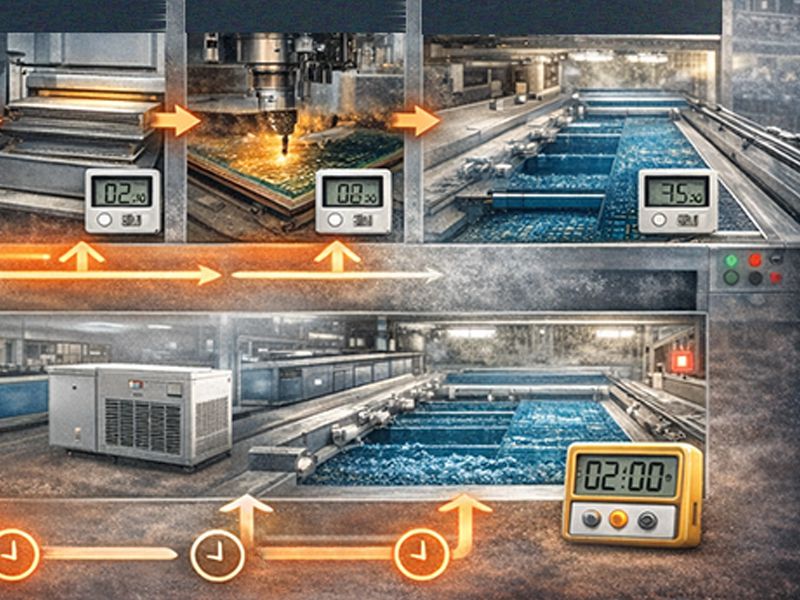
PCB Industry Case Study
End-to-End Environmental, Humidity & Time Control
In PCB manufacturing, humidity and time control are critical factors affecting process stability and product yield.
From laminate storage, inner and outer layer processing, lamination, and drilling to downstream surface finishing, insufficient control of environmental humidity or process waiting time can lead to moisture absorption, dimensional variation, reduced interlayer reliability, and ultimately become the root cause of quality defects.
Therefore, effective environmental control is not limited to isolated process steps, but requires end-to-end risk management that integrates humidity stability with precise time control across the entire manufacturing process.
This case study demonstrates how environmental, humidity, and time control solutions are practically implemented at each stage of the PCB manufacturing process, using a unified control logic to support process stability, consistency, and defect rate reduction under varying production conditions.
Application Scenario|Quality-Critical Across the Entire Process
During the storage of laminates and semi-finished materials, humidity control focuses on preventing moisture absorption and material deformation, while maintaining stable conditions to extend allowable holding time and reduce quality risks caused by excessive waiting or rework.
In inner and outer layer processing environments, humidity must be managed to accommodate fluctuations introduced by production tempo, operator activity, and equipment operation, preventing short-term humidity variations from affecting circuit precision and process stability.
During lamination, drilling, and critical process transfer stages, stable humidity conditions combined with controlled exposure time help reduce interlayer stress and variability, minimizing the risk of latent defects.
In downstream surface finishing and finished goods staging, long-term stable, low-interference environmental and time control ensures consistent product quality while reducing rework rates and defect occurrence.
Process Implementation|Equipment Configuration Aligned with PCB Materials and Workflows
To address the diverse material types and operational workflows in PCB manufacturing, this case study deploys tailored environmental, humidity, and time control equipment based on specific process requirements.
During the storage and movement of PCB panels, carts, and transfer units, stable environmental conditions are maintained to prevent moisture absorption and dimensional variation caused by waiting time and environmental fluctuations.
In front-end processes and SMT-related applications, intelligent paste warming cabinets, solder ball warming cabinets, and dry film warming cabinets are implemented to ensure materials complete conditioning and staging under controlled humidity and time parameters, reducing process variability caused by uneven warming or uncontrolled exposure time.
For materials requiring low-temperature storage, freezer storage cabinets integrated with RFID-based control mechanisms are deployed to enable effective tracking and management of material access, conditioning, and usage time, preventing overtime exposure, misuse, or human error.
In addition, for highly hygroscopic materials such as reel-based components and copper foil, dedicated reel storage cabinets and intelligent copper foil storage systems maintain stable humidity conditions during long-term storage and process transitions, minimizing material state variation and supporting downstream process consistency and quality stability.
Core Challenge|Uncontrolled Humidity and Time as the Root Cause of Defects
PCB manufacturing involves multiple process stages. Even when individual stations temporarily meet environmental specifications, inadequate control of humidity fluctuations and waiting time across the overall process can still manifest as quality defects or reliability issues in downstream stages.
The true risk, therefore, does not originate from a single process step, but from the cumulative effect of humidity and time exposure throughout the entire manufacturing flow.
Solution Approach|An End-to-End Humidity and Time Control Strategy for Process Consistency
This case adopts an environmental, humidity, and time control strategy centered on end-to-end process consistency.
Rather than focusing solely on setpoints, the system design emphasizes humidity fluctuation range, recovery performance, actual dwell time, and long-term operational stability and reliability.
Through stable control mechanisms and continuous monitoring, predictable environmental conditions are maintained across different process stages, even under real-world production rhythms.
Measured Results|Reduced Variability Supporting Yield and Process Stability
Through this end-to-end environmental, humidity, and time control framework, environmental fluctuations and moisture absorption risks across all PCB process stages are effectively reduced. Process conditions become more consistent, and quality variation is significantly minimized.
The environment is no longer a hidden variable affecting process stability and yield, but a critical foundation supporting manufacturing efficiency, quality consistency, and defect rate improvement.
Truly effective PCB environmental control requires the simultaneous management of both humidity and time to continuously reduce defect risk throughout the entire manufacturing process.
Published on December 20, 2025